
More Intellectual Property to Worry About: Typefaces and Fonts
Just as decisions about many elements of a film or television project contribute to a story’s overall impact, so can selection of a typeface for the written word. When we are reading text, the meaning of the information can change when different typefaces are used. Here is an example:
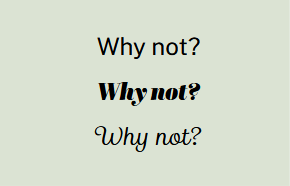
The first has a neutral vibe. The second seems a bit more aggressive. The last of the three looks is playful. Each has a different message created by the presence or absence of serifs, the thickness and form of the lines, and the connectedness of the letters.
And guess what (newsletter time!): there are intellectual property issues to consider when selecting how your words will look. Copyright protection for typefaces varies from country to country. In the U.S., typefaces cannot be copyrighted. They do have various forms of protection similar to copyright in other countries though, such as in the U.K., France, and Germany. Trademark registration can give a distinctive typeface more protection in every country; the U.S. Coca-Cola’s logo comes immediately to mind. An important distinction to keep in mind in this conversation is the difference between typeface and font, as described here by Ross Kimbarovsky in a blog on the topic:
Technically, a “font” is a computer file or program (when used digitally) that informs your printer or displays how a letter or character is supposed to be shown.
A “typeface” is a set of letters, numbers, and other symbols whose forms are related by repeating certain design elements that are consistently applied (sometimes called glyphs), and used to compose text or other combinations of characters. Although many people would call “Helvetica” a font, it’s actually a typeface. Variations of Helvetica, such as Helvetica Regular, Helvetica Italic, Helvetica Bold, etc., are fonts. The software that tells your display or printer to show a letter in “Helvetica” is the font.
www.crowdspring.com/blog/font-law-licensing
When you access a font online for use in your project, you’ll want to find out the font’s copyright status. If protected, you’ll need a license for its use. Using an unlicensed font in a two-second clip of a character glimpsing a computer screen will bear much less scrutiny than use of that font in a publicity campaign for your project (one-sheets, online ads, trailers). This practice of licensing fonts should be a well-honed tool in your art department’s kit. There are many online sources of public domain fonts, among them Font Squirrel (fontsquirrel.com) and the Google Fonts library (fonts.google.com)
Originally published Spring, 2025